
AI-Generated Content Library
Duration
2025 Summer
12 Weeks
Position
Product Design Intern
Team
Goodnotes AI-Assisted Note-Taking & Editing
Skills
Figma, Interaction Design, User Testing, User Research

Background
I was selected from a global pool of applicants to work onsite at Goodnotes’ Hong Kong office for 12 weeks as part of the AI-Assisted Note-Taking & Editing team.
Project Team
Isaiah Hoagland
Product Design Intern
Felix Kok
ML Engineer Manager
Leo Lau
AI Team Design Manager
Feli
Product Manager
My Role
During my Summer 2025 internship at Goodnotes in Hong Kong, I led six moderated usability testing sessions with knowledge-worker professionals to inform both near-term product decisions and longer-term AI strategy. Insights from this research directly shaped two initiatives I owned:
-
Future-facing AI Sandbox redesign focused on reuse, iteration, and creative workflows
-
MVP concept for an AI generation history library supporting revisiting and branching past outputs
This case study focuses on redesigning the AI Sandbox to shift AI output from a one-off, disposable result into a flexible, referenceable workspace that supports deeper exploration.
MVP Prototype
Problem & Importance
Users cannot revisit, edit, or reference past AI-generated content once accepted or declined in Sandbox.
Usability testing revealed that participants frequently tried to switch between tasks, ask unrelated questions, and return to prior work. This exposed gaps in navigation and iteration workflows.

This limits AI engagement to one-off use and prevents the Sandbox from scaling into a durable, high-value workspace for future AI expansion.
Direct Solution #1

Impact
I improved navigation and reuse, reduced redundant work, and established the foundation for scalable AI workflows in future Sandbox updates.
Additional Solution #2
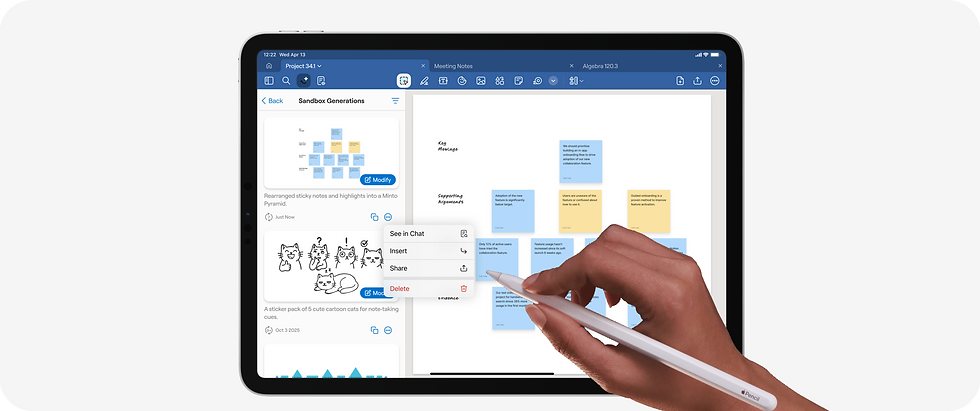
I proposed and led the design of an AI content library called Source Cards, enabling users to save, access, and reuse past generations directly within Sandbox.
I improved navigation and reuse, reduced redundant work, and established the foundation for scalable AI workflows in future Sandbox updates.
Research
Field Testing
I led six moderated usability testing sessions with knowledge-worker professionals, synthesizing 60+ findings and quick fixes that informed development prioritization and future product strategy.
My role:
-
Designed and administered participant screeners
-
Led six one hour moderated usability testing sessions
-
Partnered with my manager, Leo Lau, to synthesize 60+ usability findings into actionable insights

Why it's Important & Timeline

Findings Summary
We synthesized over 60 findings into a prioritized table, ranked by impact and confidence to guide development decisions.

Common Themes & Early Explorations
To summarize the findings, I focus on the key themes that directly informed my work, outlining the problem, insight, proposed solution, and trade-offs for each. While additional insights emerged from the research, those were shared with other teams or deferred for longer-term exploration.
01 / Future Sandbox Window
My initial project scope explored a full redesign of the Sandbox AI experience, but due to ambition, technical feasibility, and timeline constraints, the work focused on early-stage explorations.
To summarize the findings, I focus on the key themes that directly informed my work, outlining the problem, insight, proposed solution, and trade-offs for each.
While additional insights emerged from the research, those were shared with other teams or deferred for longer-term exploration.

Finding:
Users wanted to revisit and edit past generations, view AI content at a larger scale, and work within a dedicated focus state rather than a transient modal.
Solution:
Redesign the Sandbox Hub into an Active Playground. A focused workspace where users can edit, revisit, and manage AI-generated content before inserting it into their notes.
Trade-offs:
Requires additional engineering effort to support editing, history, and content management within a single workspace
Version 1

Concept:
Centralized chatbot view with a dedicated generation canvas. Prompt history lives on the left, modification tools on the right, and the source card title at the top links to the Source Card library.
Trade-off:
The layout may feel visually dense and crowded on smaller screens.
Similar to V1, but with the chatbot and modification tools consolidated on the left.
Trade-off:
The left panel becomes dense and visually crowded, especially on smaller screens.
Similar to V2, but introduces a chatbot overlay on top of the image canvas, utilizing floating UI elements to keep the output as the primary focus while enabling in-context edits and follow-up prompts.
Early Exploration of AI Sandbox Hub UI Sketches
Version 2

Version 3

Mid-fi

01 / Future Sandbox Window
Enhance prompt button within prompt box

Finding:
Typing detailed prompts on iPad is cumbersome and discourages iteration.
Solution:
I added an Enhance Prompt action that expands short inputs into clearer, more instructional prompts.
Trade-offs:
Reduces typing effort and improves prompt quality, but requires an undo state and careful space management in the chat UI.
01 / Future Sandbox Window
Preview and Insert on Canvas Control

Finding:
Typing detailed prompts on iPad is cumbersome and discourages iteration.
Solution:
I added an Enhance Prompt action that expands short inputs into clearer, more instructional prompts.
Trade-offs:
Reduces typing effort and improves prompt quality, but requires an undo state and careful space management in the chat UI.
Scoping Down Features
With the three directions my project can follow I connected with engineers and Pms to scope which one I can continue with for the rest of my internship.
We ended up focusing on a source generation card library system.
We sought feedback to determine whether to pursue all three features or narrow the scope to one or two that would deliver the greatest value within the next three weeks.
We also worked with engineers to identify high-effort or backend-dependent features, and with PMs to assess business impact, including which single feature would provide the highest value if only one could launch this year.
Process behind the MVP
AI-Generated Content Library
More to come! Case study in progress..
Learnings & Reflection
This was my first industry internship, and the learning curve was steep. Here are the key areas where I grew, the unexpected lessons that shaped my approach, and the long-term impact this experience had on me.
Early communication and frequent check-ins help align scope, feasibility, and execution across teams
This project highlighted how critical early and frequent communication is when working cross-functionally with PMs and engineers. Sharing ideas through low-fidelity wireframes and concept reviews early on helped align feasibility, scope, and expectations before designs became too detailed, leading to faster feedback and stronger shared understanding.
Design requires balancing curiosity with real-world constraints
Working on a real product taught me to prioritize feasibility alongside impact. I learned to make informed trade-offs, adapt designs to scope and constraints, and focus on the changes that would meaningfully move the product forward.
Internship @
